
Waste Systems and Financial Sustainability: Beyond Investment
The world produces over 2 billion tonnes of municipal solid waste annually, a figure set to rise sharply by 2050. Despite ongoing efforts to improve sustainability, the vast majority of this waste remains improperly managed, often burned, disposed in waterways, or left in open dumps.
The global perception of the waste management challenge is misguided. The blueprints for a successful system are widely available and understood; the failure lies in how these systems are financed and sustained.
Where the pressure actually sits
Waste systems are cost-intensive to operate and generate limited revenue. Their cost profile is shaped by large recurrent expenditures of collection, transport, and service delivery, rather than initial capital investment.
Capital funding is often available, with donors, development banks, and climate funds willing to finance trucks, landfills, transfer stations, and even advanced treatment facilities. In many cases, the initial investment is not the limiting factor.
With approximately 70% of costs being recurrent expenditures – labour, fuel, maintenance, and management. Even basic collection services can consume 30–40% of municipal budgets in low-income contexts. The scale of these costs become clearer when considered as a progression. As systems move beyond basic collection to include recycling, sorting, and treatment, each additional service layer introduces further costs for the municipality.
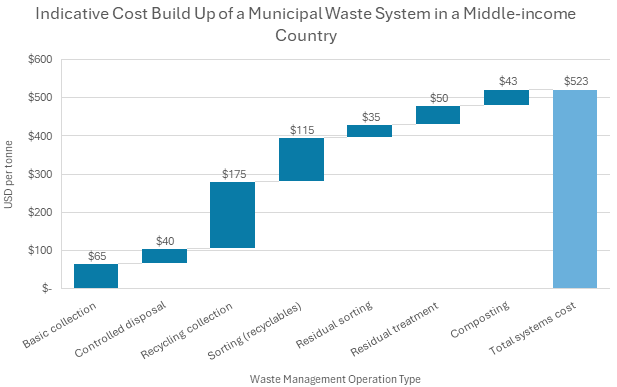
The chart illustrates how costs accumulate as systems become more advanced, driven by additional service requirements, rather than one-off capital investment.
Where revenue is limited or volatile, maintaining service levels becomes challenging. Without stable and predictable revenue streams, systems begin to break down: collections become irregular, facilities are not maintained, and service coverage gradually contracts.
These dynamics are not confused to low-income settings. Even in high-income contexts, waste systems remain vulnerable where operating models are tightly constrained. Recent disruptions to collection services in Birmingham illustrate how quickly service reliability can deteriorate when operational costs, labour structures, and funding arrangements fall out of balance.
In practice, there is a focus on infrastructure delivery, with less attention given to how systems are financed once operational, and ensuring sustainable performance.
What cost recovery looks like in practice
Waste streams are typically dominated by organic material, with limited commercial value. Plastics and metals offer opportunities for value recovery, but the revenues generated are rarely sufficient to support the system. In practice, recycling and resource recovery can offset costs, but are not large enough to fund operations.
Financial modelling of waste systems point to a consistent pattern. Revenues are constrained by the composition of waste and fluctuating commodity markets, while costs are driven by service delivery requirements that are largely fixed and ongoing.
In higher- and middle-income cities, stronger collection systems and greater volumes of recyclable materials create some opportunities for revenue generation. However, these revenues are limited and volatile. They can contribute to system financing, but they do not provide a stable or sufficient basis for covering operational costs.
The opportunity for cost recovery declines further in lower-income contexts. Waste streams are dominated by organic material, while collection systems are less developed and more costly to operate. Financial models derived from higher-income systems do not translate.
Markets already operate within the waste system. Across many cities, informal collectors and waste pickers efficiently extract value from the waste stream, targeting materials with immediate resale potential. If a material has value, it is already being captured. The challenge is everything that does not.
Low-value, organic, and residual waste – the majority of the waste stream – attracts limited investment and is consistently underserved. The cost of managing this residual waste remains, even if revenue opportunities do not.
Who carries the financial burden
Municipalities are left absorbing the gap between the cost of managing waste and the revenues that can be generated from it. In most cases, services are funded through general taxation or limited user fees. As costs and expectations rise, this model becomes increasingly difficult to sustain.
Public funding alone cannot close this gap. The majority of the waste stream carries little to no recoverable value, while the costs of managing it are continuous and unavoidable. Expecting local governments to absorb this deficit, particularly in lower-income contexts, is not realistic. In some lower-income and rural contexts, the use of public collection points and disposal facilities assist in reducing waste collection costs from municipalities, however this is not enough.
What is required is a reallocation of who pays. Waste is generated across the economy, but the financial burden of managing it remains concentrated at the municipal level.
A viable system requires a broader financial base. Instruments such as extended producer responsibility, tariffs, environmental taxes, and carbon finance offer opportunities to redistribute the financial burden of the operating expenditure across the system.
There is a clear misalignment between where waste is generated and where the cost of managing it sits.