


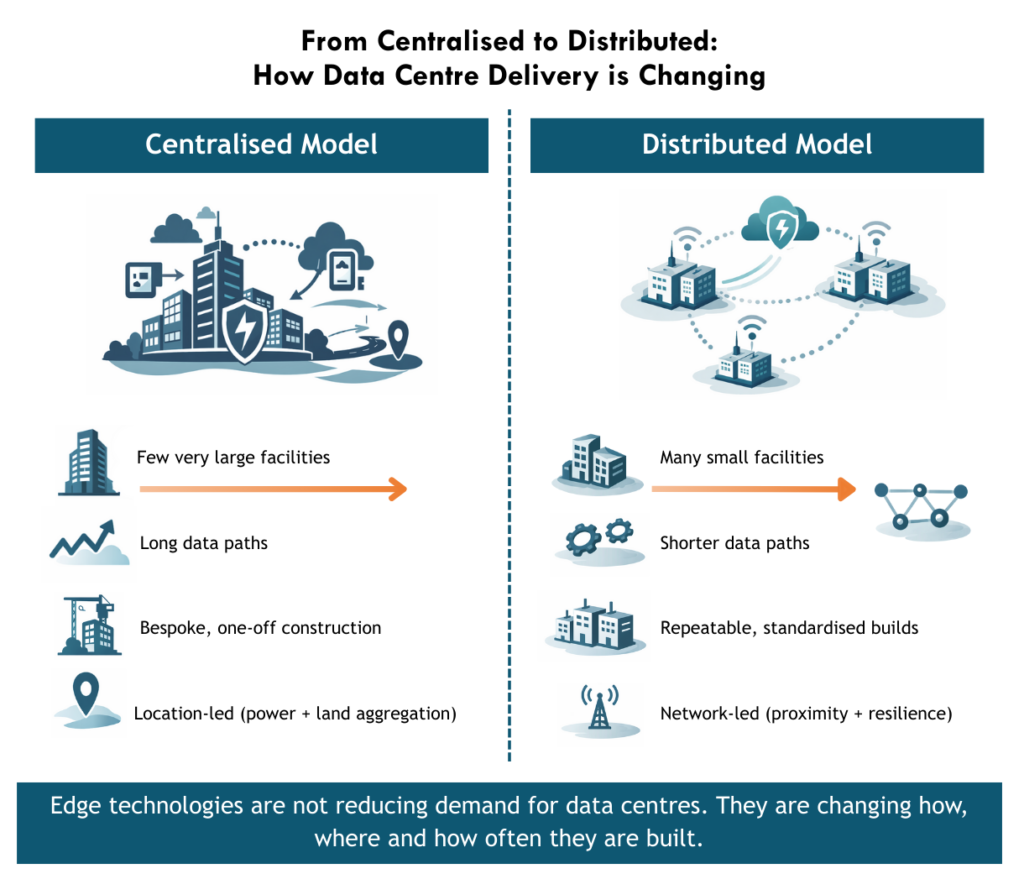
For several years, discussion around edge technologies has been accompanied by an assumption that processing data closer to where it is generated will ultimately reduce the need for large, centralised data centres. For those involved in construction, this has raised a reasonable question: does the growth of edge technologies imply a slowdown in data-centre development?
The short answer is no. What edge technologies are doing is not reducing demand for data centres, but reshaping it. The implications for the UK construction sector are therefore not about contraction, but about a shift in project scale, geography and delivery model.
What edge technologies actually do
Edge technologies enable data to be processed closer to where it is generated, rather than relying exclusively on distant, centralised data centres. This improves latency, resilience and responsiveness, particularly for applications that require real-time decision-making or operate in constrained network environments.
However, edge technologies do not replace the need for core data-centre infrastructure. Central facilities remain essential for long-term data storage, artificial intelligence model training, system orchestration and governance. In practice, edge technologies support a layered digital infrastructure model, combining central, regional and edge facilities.
For construction, the relevance of edge technologies lies not in reducing the need for data centres, but in changing where and how they are delivered.
What the evidence says about UK data-centre demand
Evidence points clearly to continued growth in demand for digital infrastructure in the UK. Government commentary from the Department for Science, Innovation and Technology (DSIT) consistently highlights the strategic importance of compute capacity in supporting artificial intelligence, digital public services and data-intensive economic activity.
At the same time, data published by Ofcom shows sustained growth in data traffic, underpinned by increased connectivity, fibre rollout and the expansion of 5G networks. These trends indicate a structural increase in demand for processing, storage and resilience.
The evidence suggests that edge technologies are not dampening demand for data centres. Instead, they sit alongside broader drivers that continue to underpin the need for new digital infrastructure.
Evidence of geographic redistribution in UK data centre construction activity
While London and the South East have historically dominated UK data-centre development, trends increasingly suggest a more geographically dispersed pattern of construction activity is emerging.
Public planning records across multiple local planning authorities show a growing number of data centre schemes being proposed and approved outside traditional South East hotspots, particularly in regions where land availability, grid access and planning conditions are less constrained. This shift is reinforced by open market commentary from major property advisors such as CBRE and JLL, which consistently highlight capacity pressure around London and increasing interest in regional locations.
Industry bodies, including TechUK, have also pointed to the role of power availability and grid constraints in shaping development decisions. As edge-enabled services expand across transport, energy, manufacturing and public services, proximity to end users and infrastructure becomes more important, encouraging a more distributed approach to digital infrastructure delivery.
Demand for data centre construction is not therefore diminishing, but redistributing geographically, with clear implications for where and how construction activity is likely to emerge.
Exhibit 1: Indicative geographic pattern of UK data centre development
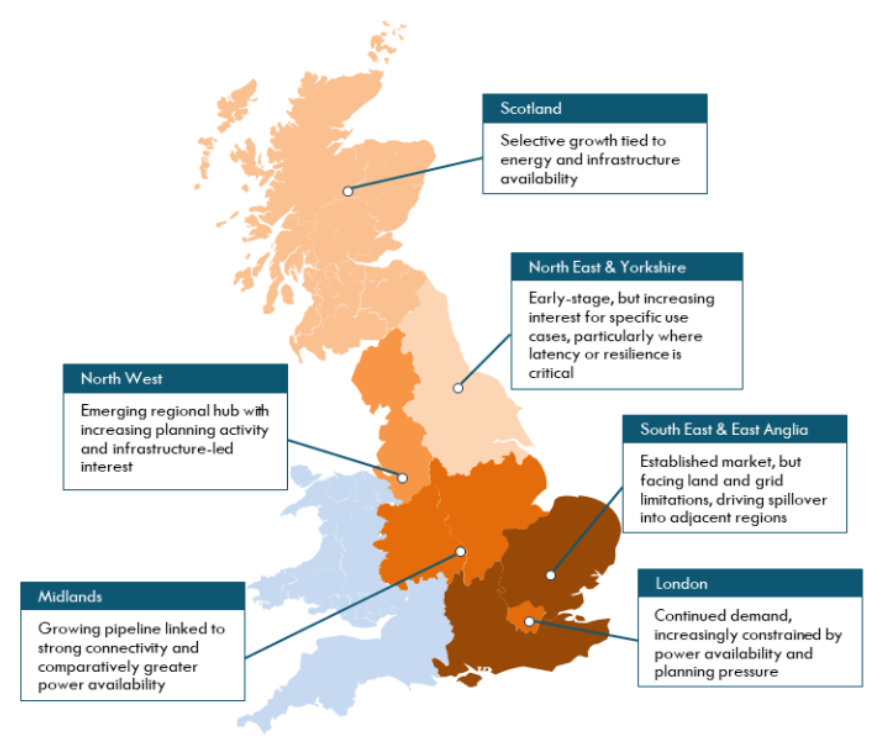
Note: This map is indicative only and reflects observable development patterns based on publicly available planning information and industry commentary. It does not represent a comprehensive inventory of projects, capacity or investment value.
Source: Misca Advisors analysis
What “more distributed” actually means for construction
A more geographically dispersed pattern of data centre development does not simply change where projects are built. It also changes the nature of construction demand itself.
As edge technologies support latency-sensitive and place-based digital services, data centre provision will no doubt increasingly favour smaller, regionally located facilities that can be delivered quickly and replicated across multiple locations. This marks a shift away from a small number of bespoke hyperscale campuses towards a larger number of repeatable, infrastructure-led projects.
From a construction perspective, the distinction is important. Distributed data centre developments will likely tend to prioritise speed, standardisation and integration with constrained sites, rather than scale alone.
Exhibit 2: How project characteristics are changing
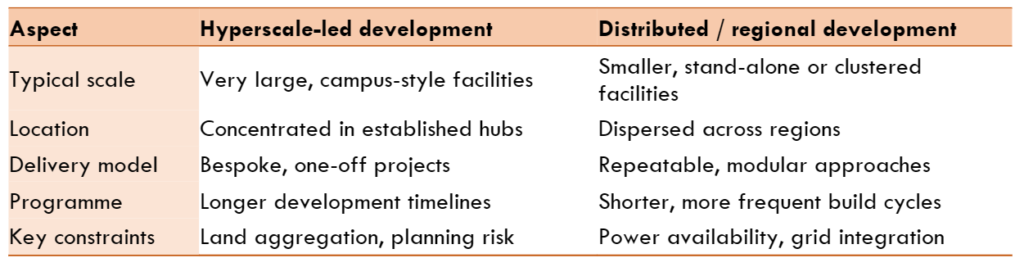
Note: This comparison is indicative and reflects observed development patterns rather than formal classifications.
Source: Misca Advisors analysis
Implications for contractors
For construction contractors, the shift towards more distributed data centre development creates a different opportunity profile. Rather than a small number of very large projects, demand is increasingly expressed through more frequent, regionally distributed schemes, often delivered under frameworks or repeat procurement routes.
This places greater emphasis on delivery capability, technical integration and the ability to operate effectively across multiple locations. Contractors with strong regional footprints, experience in mechanical and electrical delivery, and familiarity with constrained sites are likely to be well positioned.
Scale remains important, but it is no longer sufficient on its own. In a more distributed market, consistency, speed and repeat performance become critical differentiators.
Implications for building product manufacturers and suppliers
For building product manufacturers and suppliers, the changing shape of data centre construction has clear strategic implications. A more distributed market favours products that can be specified repeatedly across multiple sites, rather than bespoke solutions developed for individual campuses.
Demand is likely to increase for modular and prefabricated systems, energy-efficient components, and cooling, fire protection and resilience solutions suited to smaller facilities. Shorter delivery programmes and repeat procurement also place greater emphasis on product availability, standardisation and ease of installation.
As data centres are developed closer to end users, regional supply chains and logistics capability become increasingly important alongside technical performance.
What this means for the UK construction sector
Edge technologies should not be viewed as a threat to data centre construction. Instead, they represent a structural shift in how digital infrastructure is planned and delivered in the UK.
Demand for data centres remains strong, but it is increasingly expressed through smaller, more numerous and more geographically dispersed projects. For the construction sector, this reshaping of demand has implications for capability, geographic strategy and delivery models.
Firms that recognise this shift early, and adapt accordingly, will be better placed to respond to the next phase of digital infrastructure investment across the UK.
Evidence sources
This article draws on publicly available UK government and regulatory publications, including those from the Department for Science, Innovation and Technology and Ofcom; publicly accessible local planning authority records; and open industry commentary from CBRE, JLL and TechUK.